
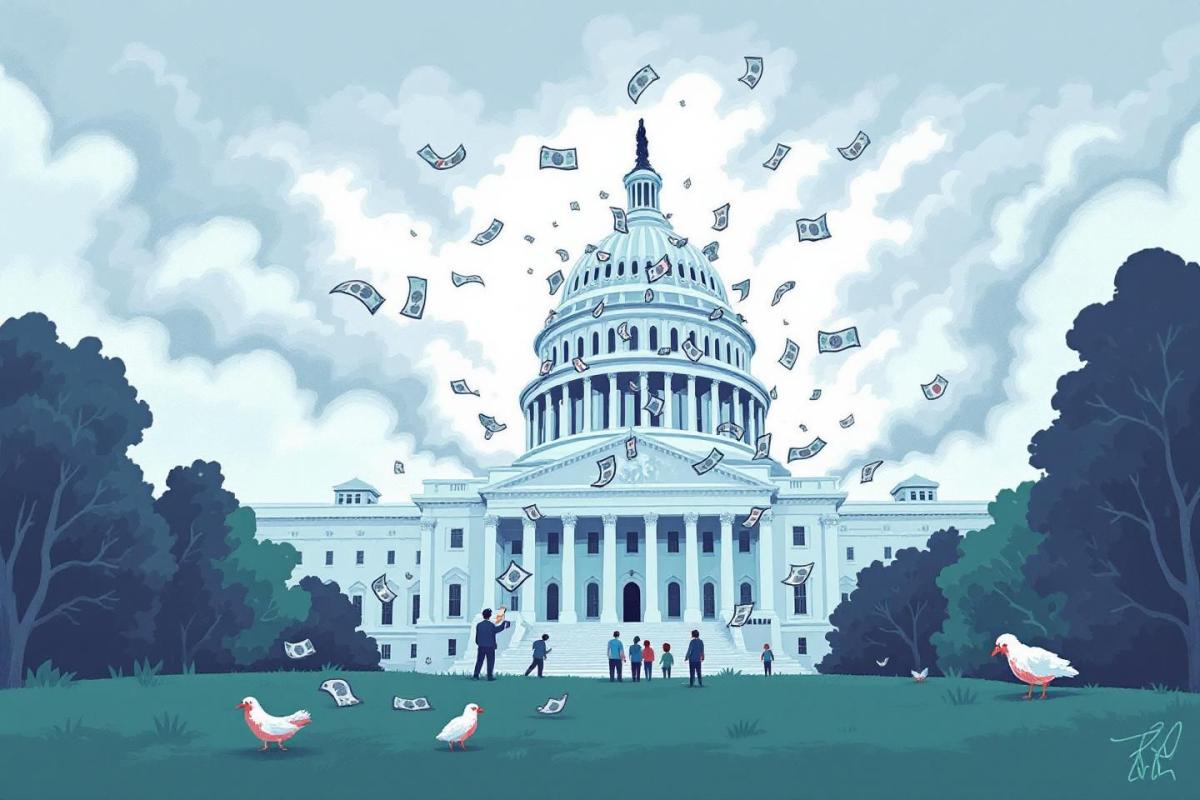
When governments create excessive amounts of currency, they unleash economic forces that can devastate entire nations. This monetary phenomenon has occurred throughout history, leaving behind valuable lessons about the delicate balance between fiscal policy and economic stability. The temptation to solve societal problems through money printing appears attractive, yet the consequences prove far more damaging than the original issues.
The power of seigniorage allows governments to acquire goods and services by creating new currency. This unique ability represents both an opportunity and a dangerous trap. While printing money might seem like an elegant solution to feed the hungry or house the homeless, excessive monetary creation leads to severe economic disruptions that ultimately harm the very people governments aim to help.
Historical examples of monetary excess and their devastating impacts
Throughout history, numerous countries have fallen victim to the allure of unlimited money creation. Germany experienced hyperinflation twice, with the most famous episode occurring in the Weimar Republic when currency became so worthless that people used wheelbarrows to carry cash for basic purchases. Hungary, Ecuador, Bolivia, Peru, and Zimbabwe in the 20th century all suffered similar fates, demonstrating that no nation remains immune to these economic laws.
The United States itself provides multiple cautionary tales. Before independence, colonial governments held printing rights and succumbed to their own excesses. During the Revolutionary War, the Continental Congress authorized Continental dollars in 1775, but overissuance and British counterfeiting reduced their value dramatically. By 1779, these notes were worth only one twenty-fifth of their original value, creating the lasting phrase “not worth a continental.”
The Confederate government during the Civil War demonstrated similar patterns. From 1861 to 1864, they increased their money stock ten-fold, with prices rising proportionally. This historical pattern reveals a consistent truth : excessive money printing always results in proportional price increases, regardless of the country or time period involved.
| Country/Period | Money Supply Increase | Price Impact | Economic Outcome |
|---|---|---|---|
| Continental Congress (1775-1779) | Massive overissuance | 96% value loss | Currency collapse |
| Confederate States (1861-1864) | 10-fold increase | Proportional price rise | Economic disruption |
| Weimar Germany (1920s) | Exponential growth | Hyperinflation | Complete collapse |
| Zimbabwe (2000s) | Unlimited printing | Trillion-percent inflation | Currency abandonment |
Why printing money fails as an economic solution
Money functions primarily as a facilitator of exchange between people, acting as an intermediary in trade relationships. Printing additional currency only affects the terms of trade between money and goods without changing fundamental economic relationships. When money supply increases relative to goods and services produced, currency becomes devalued, impairing money’s ability to accurately measure value.
A simple example illustrates this principle effectively. If corn costs one dollar per pound and everyone earns one hundred dollars monthly, people can purchase one hundred pounds of corn. When government gives everyone an additional hundred dollars, increased demand drives corn prices to one dollar and fifty cents per pound, creating inflation. While firms might hire workers to meet increased demand, higher wages and worker expectations for increased pay to maintain purchasing power erode profits, limiting actual employment gains.
This mechanism reveals why simply creating more money cannot solve fundamental economic problems. The underlying issue lies in the relationship between available goods and services versus the money chasing them. Increasing money supply without corresponding increases in production merely shifts the problem rather than solving it.
Key reasons why money printing fails include :
- Distorted price signals that prevent efficient resource allocation
- Reduced purchasing power for existing currency holders
- Economic uncertainty that discourages long-term investment
- Wealth redistribution from savers to debtors and government
- International confidence loss in the currency’s stability
Central bank independence and accountability in monetary policy
The transition from gold-backed currency to fiat systems fundamentally changed monetary dynamics. Historically, governments restrained money printing by tying currency value to commodities like gold. Since governments didn’t control gold production, money printing remained limited by gold holdings. However, gold standards proved restrictive during periods of high currency demand, such as financial crises or seasonal agricultural needs.
Modern central bank design addresses these challenges through careful institutional structure. Since elected officials with direct money supply control could cut taxes and print money to buy votes, making their promises not credible, money supply control was delegated to nonelected central bank officials. This separation aims to insulate monetary policy from short-term political pressures.
A well-designed central bank must exhibit four essential characteristics. First, it must be credible in its commitment to price stability. Second, it requires independence from political interference to make difficult decisions. Third, it needs accountability mechanisms to ensure responsible behavior. Fourth, it must maintain transparency in its operations and decision-making processes.
The Federal Reserve exemplifies this institutional design, though critics argue it has failed in its primary mission. The Fed has overseen a ninety-seven percent decline in the dollar’s value since its creation, effectively transferring this wealth from citizens to government through inflation’s hidden tax mechanism.
Wealth transfer mechanisms and economic consequences
Inflation functions as a sophisticated wealth redistribution system, transferring purchasing power from currency holders to those who first receive newly created money. The government benefits most from this arrangement, as it can spend new currency at current prices before inflation affects the broader economy. This process represents a form of financial taxation without explicit legislative approval.
The Federal Reserve’s operational cycle perpetuates this wealth transfer. It creates money for government spending, causing inflation, then contracts money supply by targeting private sector demand rather than reducing government money supply. This approach makes American citizens collateral damage in fighting inflation the Fed itself created through excessive monetary expansion.
When money supply contracts, borrowing costs increase dramatically. Economic activity slows as consumers lose access to cheap credit. Businesses experience declining sales, leading to workforce reductions as the economy transitions from expansion to recession. The Fed operates under theories requiring crushing private sector demand to control inflation, explicitly seeking to soften labor markets and pressuring employers to end wage increases.
This cycle reveals the fundamental misconception in current monetary policy. Paying employees less doesn’t reduce money circulation; it merely shifts money from employees to business owners who spend differently on advertising or inventory. The real solution requires shrinking government size so the Fed doesn’t need to supply ever-growing cash amounts, allowing interest rates to find natural market levels without artificial manipulation.